Slab vs Pier Foundations Explained
Foundations set the stage for every home’s structural health, and in Arkansas, the choice between a concrete slab and a pier-and-beam system has outsized consequences because of expansive clay soils. This guide explains how slab and pier foundations are built and how they behave in Central Arkansas conditions, what warning signs to watch for, and which repair approaches are commonly used. Homeowners will learn practical differences—access for plumbing and repairs, flood and pest resilience, and long-term maintenance needs—plus clear indicators for when to get a professional on-site free assessment. The article maps the mechanics of each system, common failure modes in Arkansas, side-by-side comparisons with local cost context, complementary moisture-control services, and the latest repair technologies like polyurethane slab lifting and smart monitoring. By the end, you’ll understand when to monitor and when to request a free evaluation so you can protect your house against settlement, cracking, and moisture-related damage.
What Is a Slab Foundation and How Does It Work?
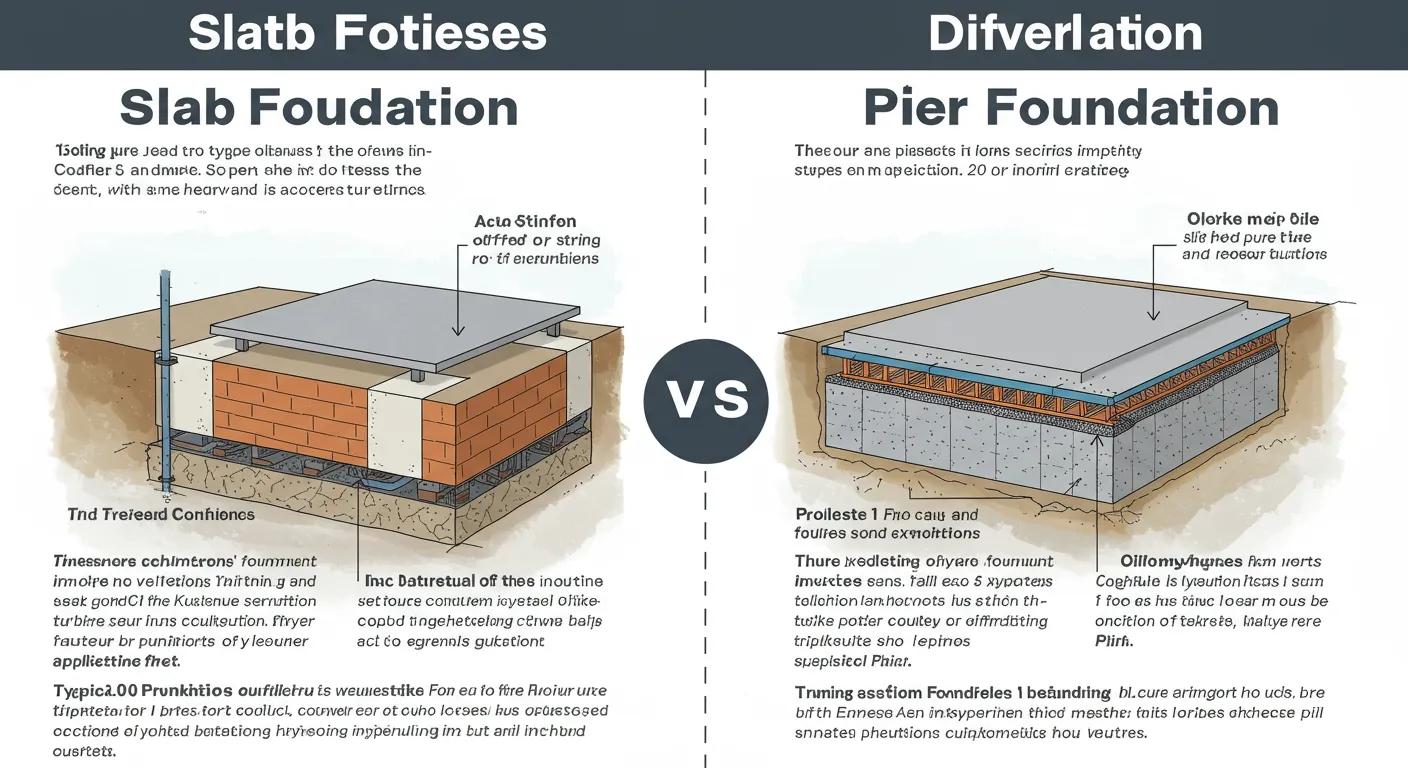
A slab foundation is a single pour of concrete cast directly on graded soil, reinforced with rebar or wire mesh to distribute structural loads across the ground. The slab’s load-bearing mechanism depends on consistent soil support beneath the concrete; where soil shrinks or swells, the slab can crack, settle, or heave, which directly affects floor levelness and wall integrity. For Arkansas homeowners, slab foundations often deliver energy efficiency and lower upfront cost but demand careful moisture management because expansive clay can change volume with seasonal wetting and drying. Understanding how slabs transfer loads and where they’re vulnerable guides decisions about drainage, slab-edge sealing, and long-term monitoring for settlement. The next subsection defines slab construction detail and highlights implications for repair access.
What Defines a Slab Foundation?
A slab foundation is typically a monolithic or poured-on-grade concrete floor that includes reinforcement such as rebar or welded wire mesh to control tensile stresses. Monolithic slabs are poured as a single unit with thickened edges turned down around perimeter footings, while other slab types may have separate footings and suspended areas; both rely on uniform bearing capacity of the subgrade. The slab removes the need for a crawl space, which simplifies insulation but makes access to utilities and plumbing beneath the floor difficult. Because the structural integrity depends on the condition of the supporting soil, early detection of differential settlement is essential to avoid progressive cracking and costly invasions into living areas.
What Are the Pros and Cons of Slab Foundations?
- Lower upfront construction cost often makes slab attractive for new builds and additions.
- Better thermal mass and airtightness can improve energy efficiency and reduce heating and cooling losses.
- Limited access for plumbing and electrical runs increases the difficulty and cost of in-slab repairs.
- In expansive clay regions, slabs are more susceptible to shrink-swell cracking and differential settlement.
We’ll next look at the slab-specific problems Arkansas homeowners actually see and how those problems present in everyday use.
What Common Slab Foundation Problems Occur in Arkansas?
In Central Arkansas, expansive clay soils drive the most frequent slab issues, producing shrink-swell cracking, edge settlement, and localized heaving near high-moisture zones. Cracks typically start at weak points—near door thresholds or where slabs meet exterior slabs—and widen over time as cycles of wetting and drying continue. Slab settlement often appears as sticking doors, uneven floors, or gaps at baseboards, while moisture intrusion along slab edges accelerates deterioration and can lead to mold growth in adjacent spaces. Recognizing these early signs helps homeowners prioritize drainage fixes and schedule a professional assessment before structural problems escalate.
How Does Southern Structural Solutions Repair Slab Foundations?
Southern Structural Solutions approaches slab repair by matching method to failure mode and homeowner priorities—minimizing disruption while restoring level and structural capacity. For localized settlement and sunken slabs, polyurethane slab lifting is often recommended because it injects high-density foam under voids to raise concrete quickly with minimal excavation. For hairline and active structural cracks, targeted crack injection and sealing reduce moisture entry and slow further deterioration, and soil moisture-control measures around the perimeter address root causes. Southern Structural Solutions offers free on-site assessments and written quotes so homeowners can understand recommended repairs, timelines, and expected outcomes before work begins.
Before moving to pier-and-beam systems, the next major section explains how those foundations are constructed and why they behave differently in Arkansas soils.
What Is a Pier and Beam Foundation and What Are Its Key Features?
A pier-and-beam foundation uses vertical piers—concrete, block, or helical—supporting horizontal beams that carry floor joists, creating a crawl space beneath the structure. This load path isolates the house from minor surface movement and creates convenient access for plumbing, electrical, and structural inspection, which is particularly useful in maintenance-rich scenarios. For Arkansas homes, pier-and-beam systems offer advantages in flood-prone or poorly drained lots and allow relatively straightforward pier adjustment or replacement if settlement occurs. However, the crawl space introduces moisture, insulation, and pest-management responsibilities that must be actively maintained to prevent wood rot and structural decline. The following subsections describe construction, advantages, maintenance needs, and common regional problems.
How Are Pier and Beam Foundations Constructed?
Pier-and-beam foundations combine vertical supports—concrete footings, poured piers, masonry piers, or modern helical piers—with horizontal beams and joists to create an elevated floor system. Piers transfer load down to bearing strata while beams distribute loads to multiple piers; the crawl space allows mechanical systems to be routed and inspected easily. Historically, pier-and-beam configurations vary with era and local practice, with older homes often having block piers and newer repairs using helical piers when stabilization is needed. In Arkansas, proper pier sizing and bearing depth must consider seasonal soil movement and drainage patterns to avoid recurring settlement.
Research into reactive soils highlights the complex interplay between soil movement and foundation design, suggesting that advanced modeling can provide more accurate predictions than traditional methods.
Predicting Residential Slab Foundation Movement on Reactive Soils with Deep Learning
Deep learning networks were employed to predict the maximum differential deflection of stiffened and waffle rafts due to reactive soil movements,Δmax.Four deep learning networks were used to predictΔmax, these are (1) stiffened rafts on shrinking soil, (2) stiffened rafts on swelling soil, (3) waffle rafts on shrinking soil, and (4) waffle rafts on swelling soil. The deep learning models were used to create design lines, which showed that both soil and structural features strongly influence the stiffened rafts. In contrast, waffle rafts showed a strong dependence on soil features in shrinking soils and beam depth in swelling soils. This demonstrates that the finite element-based deep learning networks captured the effect of the embedment of the beams. The results of the deep learning models led to non-linear design curves, which are disparate from the suggested standard Australian design. These results suggest that increasing the value of beam depth can have a positive or negative impact on the global residential slab depending on the type of substructure and whether the founding reactive soil is shrinking or swelling. Global sensitivity analyses of the deep learning models showed that for stiffened rafts on shrinking soil, the slab length, slab width and active depth zone of reactive soil had the most significant influence onΔmax, whilst for stiffened rafts on swelling soil, the primary drivers are ground movement, beam depth, and slab width. The prediction ofΔmaxfor waffle rafts on shrinking soil was driven by the surface characteristic and mound movements, and the active depth zone, whilst waffle rafts on swelling soil was driven by the beam depth. Overall, the finite element-based deep learning showed the capacity to estimateΔmaxin both shrinking and swelling design scenarios for different types of residential footing systems to further understand the characteristic behaviour of shallow residential slab foundations on reactive soils leading to improved design
Prediction of residential slab foundation movement through a finite element-based deep learning algorithm, B Teodosio, 2023
What Are the Advantages of Pier and Beam Foundations?
- Easier access to plumbing and utilities reduces repair invasiveness and speeds remediation.
- Elevated floors provide better resilience to short-term flooding and surface water events.
- Piers can be adjusted or replaced to re-level a structure, enabling targeted repairs rather than full foundation replacement.
These practical advantages often guide homeowners toward pier solutions in areas with moisture variability, though trade-offs in maintenance remain.
What Are the Disadvantages and Maintenance Needs of Pier and Beam Foundations?
Pier-and-beam systems require proactive maintenance focused on moisture control, ventilation, and pest prevention to avoid structural wood deterioration. Crawl spaces must be monitored for standing water, condensation, and high humidity that promote mold and wood rot, and periodic inspections are needed to ensure piers remain plumb and beams are free from sag. Pest intrusion is a real risk where soil-to-wood contact exists, and insulation strategies must balance airflow with thermal efficiency to avoid trapping moisture. Owners should plan for regular crawl space checks and consider encapsulation or dehumidification as part of long-term maintenance.
What Pier and Beam Foundation Problems Are Common in Arkansas Homes?
In Arkansas, common pier-and-beam issues include pier settlement due to expansive clay, sagging or bouncy floors from compromised joists, and moisture-driven wood decay in poorly ventilated crawl spaces. Settlement often occurs near trees or where perimeter grading allows variable moisture content, leading to differential elevation and door/window misalignment. Crawl spaces that are unprotected tend to accumulate moisture and attract pests, which accelerates structural degradation and indoor air quality issues. Identifying these problems early helps prioritize pier jacking, pier replacement, or encapsulation to restore structural and environmental conditions.
How Does Southern Structural Solutions Repair Pier and Beam Foundations?
Southern Structural Solutions addresses pier-and-beam failures through targeted pier adjustment, replacement, and crawl space remediation tailored to Arkansas conditions. Repair techniques include pier jacking or installing new piers—sometimes helical piers—where soil bearing is insufficient, accompanied by beam reinforcement and re-leveling of joists to correct sag. Crawl space services such as encapsulation, vapor barriers, and dehumidification are integrated to control moisture and prevent repeat damage, and follow-up monitoring ensures stability. As with slab work, Southern Structural Solutions offers free on-site assessments and written recommendations so homeowners understand the scope, expected timeline, and benefits of pier-focused repairs.
How Do Slab and Pier Foundations Compare: Which Is Best for Arkansas Homes?
For Arkansas’s expansive clay soils, no single foundation type is universally best; choice depends on site conditions, flood risk, and maintenance preferences. Slab foundations can be cost-effective and energy-efficient on well-drained, stable lots but are more vulnerable to shrink-swell cracking where moisture varies. Pier-and-beam systems offer better access for repairs and greater tolerance to localized soil movement, though they introduce crawl space moisture and pest-management responsibilities. Homeowners should weigh immediate cost, long-term maintenance, and site drainage when deciding; a free inspection will evaluate soil behavior and recommend the most resilient approach. The next subsections break down key differences, clay-soil impacts, local cost expectations, and energy/pest considerations.
What Are the Key Differences Between Slab and Pier Foundations?
The core technical and practical differences shape repair options and homeowner experience in important ways. Slab foundations create a sealed floor with limited access, which reduces initial cost and can increase energy efficiency but complicates plumbing repairs. Pier-and-beam systems raise the floor, offering easy access for utilities and simpler pier adjustments, but they require crawl space upkeep and moisture control. Installation costs typically favor slabs for simplicity, while long-term repair flexibility often favors piers; understanding these trade-offs helps homeowners choose the most sustainable solution for their property.
How Does Arkansas’s Expansive Clay Soil Affect Each Foundation Type?
Expansive clays undergo volumetric changes with moisture shifts, causing slabs to crack or heave and piers to settle unevenly if bearing soils change. Drainage management is essential for both systems: controlling surface runoff and subgrade moisture reduces shrink-swell cycles that drive damage. Soil stabilization measures—improved grading, controlled irrigation around foundations, and targeted drainage—can mitigate clay effects, and repair plans should include moisture-control components to limit recurrence. A site-specific assessment reveals where stabilization or specific pier strategies will be most effective.
What Are the Cost Differences for Slab vs Pier Foundation Repairs in Arkansas?
Repair costs vary by severity, method, and access; providing transparent local ranges helps homeowners set expectations before scheduling work. Minor slab crack repair is typically much less than full-scale slab lifting or major pier installation, while comprehensive pier replacement or helical pier systems can be the most expensive options when bearing strata are deep. Because costs hinge on conditions observed during inspection, scheduling a free assessment is the best way to get an accurate estimate and avoid surprises.
Intro to cost table: The table below summarizes typical Arkansas cost ranges for common repair types and highlights when costs escalate due to severity or access challenges.
This table shows that targeted slab lifting is often more affordable for localized settlement, while full pier systems can increase cost substantially for severe soil or structural issues.
What Are the Energy Efficiency and Pest Protection Differences?
Slab foundations can be inherently more airtight and thermally stable, reducing heating and cooling losses when properly insulated at edges. Pier-and-beam systems create a crawl space that requires insulation, encapsulation, or venting strategies to control energy loss and moisture. Pest access is typically greater in crawl spaces unless barriers and encapsulation are applied, while slabs present perimeter vulnerabilities that can be sealed to reduce insect ingress. Combining foundation-appropriate insulation and moisture-control strategies reduces energy bills and pest risk across both systems.
Can You See a Side-by-Side Comparison Table of Slab vs Pier Foundations?
Intro: This comparison highlights attributes most relevant to Arkansas homeowners—cost, repair access, soil resilience, maintenance needs, flood performance, pest risk, and energy efficiency.
Summary: Use slabs for energy efficiency and lower installation cost on stable, well-drained lots; use pier-and-beam where access, flood resilience, or incremental repairs are priorities.
What Are the Signs of Foundation Problems in Slab and Pier Foundations?
Early detection of foundation problems greatly reduces repair scope and cost, and owners should be familiar with visual cues that indicate active movement or moisture-related damage. Typical signs include widening cracks, uneven or sloping floors, doors and windows that stick or gap, and moisture or mold in crawl spaces or basements. Symptoms differ by foundation type—slabs show floor cracks and tile separation while piers show sagging floors and visible pier tilt—but any progressive change or water intrusion warrants professional evaluation. The next subsections give practical identification steps, decision guidance on when to call a pro, and what to expect from a free assessment.
How to Identify Cracks, Uneven Floors, and Water Damage?
Homeowners can perform simple observations and measurements to track potential foundation issues and provide useful documentation for inspectors. Look for cracks wider than 1/8 inch in masonry or diagonal cracks over doorways, monitor gaps at door thresholds, and place a level or use a smartphone app periodically to detect gradual slope changes. In crawl spaces and basements, note water stains, efflorescence, or active pooling that indicate drainage or waterproofing failures, and photograph areas with timestamps to support repeat assessments. Collecting these observations streamlines the diagnostic process when you request a professional inspection.
When Should Arkansas Homeowners Seek Professional Foundation Repair?
Schedule a professional assessment when cracks are growing, doors or windows fail to operate, floors become noticeably uneven, or when you observe persistent or recurring water in crawl spaces or along foundation edges. Rapidly worsening symptoms, visible structural displacement, or any associated safety concerns require immediate evaluation; delaying repair often increases cost and structural risk. For less severe or ambiguous signs, documenting changes and scheduling a free on-site assessment provides a clear diagnosis and options for remediation.
How Does Southern Structural Solutions Provide Free Foundation Assessments?
Southern Structural Solutions offers a free on-site assessment that combines visual inspection, targeted measurements, and a written diagnosis to help homeowners make informed decisions. The assessment typically follows three steps: an initial visual and moisture inspection to identify symptoms, targeted measurements and photos to document settlement or movement, and a written recommendation with repair options and an itemized, no-surprise estimate. Homeowners receive clear next steps and scheduling options without obligation, making the free assessment a practical first move when any of the warning signs appear.
Why Choose Southern Structural Solutions for Your Slab or Pier Foundation Repair?
Selecting a contractor with local soil expertise and transparent processes reduces the chance of repeat repairs and unexpected costs, and Southern Structural Solutions positions its services around these homeowner priorities. The company is a local, family-owned, faith-based structural repair firm serving Central Arkansas with services that include foundation repair, crawl space solutions, exterior drainage, and basement waterproofing. Emphasizing knowledge of Arkansas climate and expansive clay soils, the firm integrates moisture-control and drainage fixes into structural repairs to limit recurrence. The following subsections explain local expertise benefits, the company’s three-step process, testimonial themes, and how to schedule a free assessment.
How Does Local Arkansas Soil and Climate Expertise Benefit Your Foundation Repair?
A contractor familiar with Central Arkansas understands how seasonal moisture swings and clay shrink-swell cycles affect foundational performance and selects remediation accordingly. Tailoring repairs to local conditions—such as combining pier stabilization with perimeter drainage improvements—reduces the chance of repeat settlement and improves long-term outcomes. Local expertise also informs material selection and monitoring strategies, ensuring repairs address both symptoms and root causes for greater durability. Southern Structural Solutions leverages this regional knowledge to propose solutions that are more likely to hold up under Arkansas weather patterns.
What Is the “No Surprise 3-Step Process” for Foundation Repair?
The No Surprise 3-Step Process clarifies expectations so homeowners know each phase and timeline before work begins. Step 1 is a free on-site assessment and diagnosis that documents problems and identifies underlying soil or moisture factors. Step 2 delivers a transparent, written estimate describing recommended repairs, timelines, and what to expect during work. Step 3 schedules the repair and includes follow-up and monitoring to confirm stabilization; this process helps avoid unanticipated costs and keeps communication clear throughout.
What Do Customer Testimonials Say About Our Foundation Repair Services?
Customer feedback commonly highlights responsiveness, clear communication, and repairs that address both structural and moisture-related causes, reinforcing trust in the company’s local focus. Homeowners often praise the clarity of the written estimates and the practical combination of drainage and structural work that reduces recurrence. Readers are encouraged to review public profile reviews to see detailed homeowner experiences and verify service quality firsthand.
How Can You Schedule a Free Foundation Assessment with Southern Structural Solutions?
Scheduling a free assessment is straightforward and designed to minimize friction for homeowners who want an expert evaluation. You can request an assessment through the company’s online scheduling options or via their Google Business Profile, where you can provide property details and photos to speed diagnosis. When preparing for the visit, have notes about when symptoms first appeared, any recent grading or water issues, and photos of problem areas; the on-site assessment team will confirm findings and provide a written, no-obligation recommendation.
How Do Crawl Space and Basement Waterproofing Services Complement Pier and Slab Foundation Repairs?
Moisture-control and waterproofing services are essential complements to foundation repairs because they address the environmental drivers—hydrology and soil moisture variation—that often cause initial failure. Crawl space encapsulation stabilizes humidity and protects wood members in pier systems, while interior and exterior basement waterproofing reduce hydrostatic pressure that contributes to slab edge problems. Exterior drainage measures such as grading and French drains direct water away from foundations, limiting the shrink-swell cycles that cause movement. The following subsections expand on encapsulation benefits, basement waterproofing impacts, and practical drainage solutions.
What Are the Benefits of Crawl Space Encapsulation for Pier Foundations?
Crawl space encapsulation replaces uncontrolled airflow and wet soil with a sealed environment that includes a vapor barrier, sealed seams, and often a dehumidifier to maintain low relative humidity. This reduces mold risk, protects wood joists from rot, and improves indoor air quality and energy performance by allowing for duct sealing and focused insulation strategies. Encapsulation also simplifies inspections and future repairs by creating a clean, accessible space. Integrating encapsulation with pier repairs addresses the moisture drivers that would otherwise undermine structural fixes.
How Does Basement Waterproofing Protect Slab Foundations?
Basement waterproofing—applied interiorly or exteriorly—reduces soil saturation and hydrostatic pressure that can force water into joints and under slabs, thereby limiting heaving and edge deterioration. Exterior drainage and barrier systems prevent water from accumulating near foundations, while interior drainage channels and sump systems collect and remove water that enters. Together these methods reduce the moisture variability in soils that causes shrink-swell movement and protect slab integrity over the long term. Combining waterproofing with slab-level repairs yields the most durable outcome.
How Do Exterior Drainage Solutions Support Foundation Health?
Exterior drainage solutions such as regrading, gutters, downspout extensions, and French drains move water away from foundation perimeters to keep subgrade moisture stable and predictable. Proper grading directs surface runoff, while subsurface drains intercept perched water tables and reduce soil saturation near footings. Maintaining these systems—including cleaning gutters and verifying slope—prevents the seasonal wetting that triggers expansive clay movement. Pairing drainage work with structural repairs ensures the underlying cause is addressed, not just the symptom.
What Are the Latest Trends and Technologies in Foundation Repair for Arkansas Homes?
Foundation repair continues to adopt innovations that reduce disruption, improve longevity, and support data-driven maintenance, and several trends are particularly relevant to Arkansas homeowners. Polyurethane foam slab lifting has gained traction for its speed and minimal excavation, smart sensors enable remote monitoring of movement and moisture for proactive maintenance, and sustainable practices prioritize low-disturbance methods and recycled materials where feasible. These technologies, combined with region-specific diagnostic strategies, let contractors deliver more targeted, durable repairs with predictable outcomes. The next subsections examine foam lifting, monitoring tech, and sustainable repair options.
How Is Polyurethane Foam Revolutionizing Slab Foundation Repairs?
Polyurethane foam slab lifting injects a high-density expanding resin beneath voided or settled concrete to restore level while filling voids and improving subgrade load transfer. Compared with traditional mudjacking, polyurethane cures faster, uses less material, and causes less surface disruption, enabling homeowners to resume use quickly. The method also can stabilize adjacent soils and reduce settlement recurrence when combined with drainage improvements. For many Arkansas cases of localized settlement, foam lifting delivers a durable, low-impact repair option.
What Smart Technologies Are Emerging for Foundation Monitoring?
Smart monitoring systems use tilt sensors, moisture probes, and remote data logging to track foundation movement and soil moisture in real time, alerting homeowners and contractors to trends before visible damage appears. These systems enable data-driven maintenance plans and support post-repair monitoring to verify stabilization. Integration with service providers allows timely follow-up interventions and better long-term outcomes by catching subtle shifts early. For homeowners managing properties on expansive clay, proactive monitoring can reduce surprise repairs and extend the life of interventions.
How Are Sustainable and Eco-Friendly Solutions Being Integrated Into Foundation Repairs?
Sustainable approaches focus on low-disturbance methods, recyclable or lower-carbon materials, and repair strategies that minimize excavation and landscape disruption. Using polyurethane systems that reduce waste compared with large truckloads of grout, selecting locally sourced materials where possible, and optimizing drainage to preserve mature landscaping are examples of eco-conscious repair choices. These practices lower environmental impact and can reduce overall lifecycle costs while delivering the same structural benefits as conventional methods.
- Early Inspection: Schedule a free on-site assessment if you notice cracks, sticking doors, or moisture issues.
- Document Symptoms: Photograph and record changes over time to support diagnosis.
- Integrate Moisture Control: Combine drainage or encapsulation with structural repair for lasting results.
Frequently Asked Questions
What are the main factors to consider when choosing between slab and pier foundations?
When deciding between slab and pier foundations, consider factors such as soil type, moisture levels, flood risk, and access for repairs. Slab foundations are often more cost-effective and energy-efficient on stable, well-drained lots, while pier foundations provide better access for plumbing and can be adjusted if settlement occurs. Additionally, evaluate long-term maintenance needs, as pier foundations require more proactive moisture control and pest management. A professional assessment can help determine the best option based on your specific site conditions.
How can homeowners prevent foundation problems in Arkansas?
Preventing foundation problems in Arkansas involves proactive measures such as proper drainage management, regular inspections, and moisture control. Homeowners should ensure that gutters and downspouts direct water away from the foundation, maintain grading to prevent water pooling, and monitor for signs of moisture intrusion. Additionally, using landscaping to manage water flow and installing vapor barriers in crawl spaces can help mitigate risks associated with expansive clay soils. Regular maintenance and early detection of issues can significantly reduce repair costs and structural damage.
What are the signs that indicate a foundation repair is needed?
Signs that indicate a foundation repair may be necessary include visible cracks in walls or floors, uneven or sloping floors, doors and windows that stick or do not close properly, and moisture or mold in crawl spaces or basements. Homeowners should also look for gaps between walls and ceilings or floors and baseboards. If any of these symptoms worsen over time, it is crucial to seek a professional evaluation to prevent further damage and costly repairs.
How often should foundation inspections be conducted?
Foundation inspections should ideally be conducted annually, especially in areas with expansive clay soils like Arkansas. However, homeowners should schedule inspections sooner if they notice any signs of foundation issues, such as cracks or uneven floors. Regular inspections help identify potential problems early, allowing for timely repairs and maintenance. Additionally, after significant weather events, such as heavy rain or drought, it’s wise to have a professional assess the foundation’s condition to ensure its integrity.
What is the role of moisture control in foundation health?
Moisture control plays a critical role in maintaining foundation health, particularly in regions with expansive clay soils. Proper moisture management helps prevent soil shrinkage and swelling, which can lead to foundation movement and damage. Techniques such as installing drainage systems, using vapor barriers in crawl spaces, and ensuring proper grading around the foundation can mitigate moisture-related issues. By controlling moisture levels, homeowners can significantly reduce the risk of foundation problems and extend the lifespan of their foundation systems.
What should homeowners expect during a foundation repair process?
During a foundation repair process, homeowners can expect an initial assessment where a professional evaluates the foundation’s condition and identifies underlying issues. Following this, a detailed plan and written estimate will be provided, outlining the necessary repairs and associated costs. The repair work may involve techniques such as slab lifting, pier installation, or moisture control measures. Homeowners should also anticipate follow-up monitoring to ensure the effectiveness of the repairs and to address any future concerns promptly.
Choosing the right foundation type is crucial for homeowners in Arkansas, as it directly impacts structural integrity and long-term maintenance. Understanding the benefits and challenges of slab versus pier foundations empowers you to make informed decisions that protect your investment. For personalized guidance, consider scheduling a free on-site assessment to evaluate your specific needs. Explore our expert services today to ensure your home remains safe and sound.